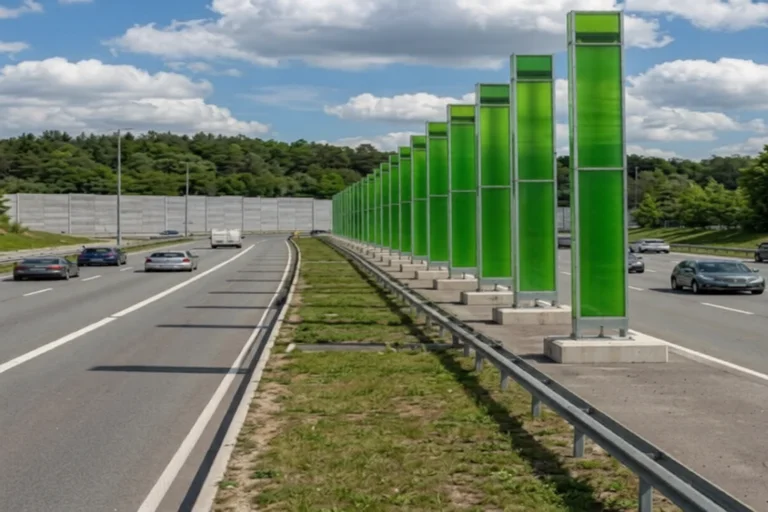
Vertical Algae Panels In Singapore A New Way To Capture Carbon
Singapore has always been a garden city, but if you look at the skyscrapers in 2026, you’ll notice something different. It’s not just more trees, it’s “living glass.” These are vertical algae panels in Singapore, and they are currently doing the heavy lifting in the city’s fight against climate change.
In simple terms, these living panels act as biological air filters, absorbing CO₂ from vehicle emissions and turning it into oxygen and useful biomass through photosynthesis. Placed where conventional trees or green spaces can’t grow, these panels help cities fight air pollution and climate change in places that most need it. In this article, we’ll explore how vertical algae panels in Singapore work, their advantages compared to traditional trees, how they fit into urban life, and what challenges lie ahead, with clear explanations throughout.
Why Algae is the Ultimate Carbon Sponge
To understand why Singapore is betting big on this, you have to look at microalgae, essentially single-celled biological engines. Unlike a tree that takes decades to mature, microalgae double their mass in hours. In terms of raw power, these engineered systems can suck up CO₂ 10 to 50 times faster than any land plant
How Vertical Algae Panels Work
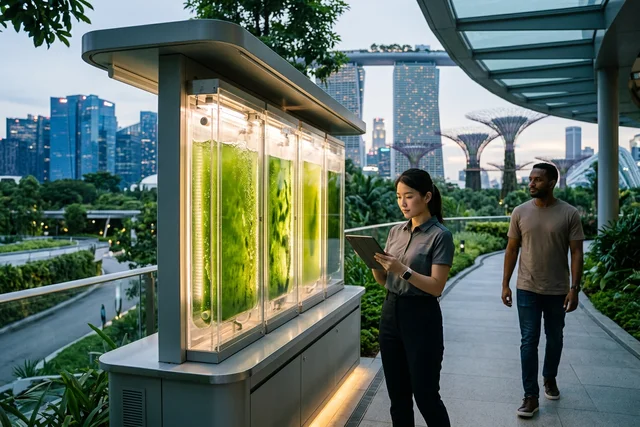
Here’s the basic science in plain language:
High-Speed Photosynthesis: Because microalgae are simple organisms, they don’t waste energy growing trunks or roots. Every part of the cell is working to turn sunlight and CO2 into fresh oxygen.
Direct Capture on Highways: We are now seeing these panels along Singapore’s busiest roads. As cars pump out emissions, the panels pull that CO2 directly into the liquid bioreactors before it can drift into the atmosphere
Maximizing Vertical Space: In a city where every inch counts, planting a forest isn’t always possible. These panels transform “dead spaces” like building facades and highway barriers into active green lungs, all without using a single square foot of ground soil.
This active biological system converts something harmful CO₂ emissions into something useful oxygen and biomass while fitting perfectly within the limits of a dense urban environment.
Urban Integration: Where Singapore Is Using Algae Panels
Singapore’s approach to climate action is holistic, tying in technology, policy, and sustainability. Vertical algae panels in Singapore fit into this vision by being installed in places where traditional greenery would be impractical or impossible.
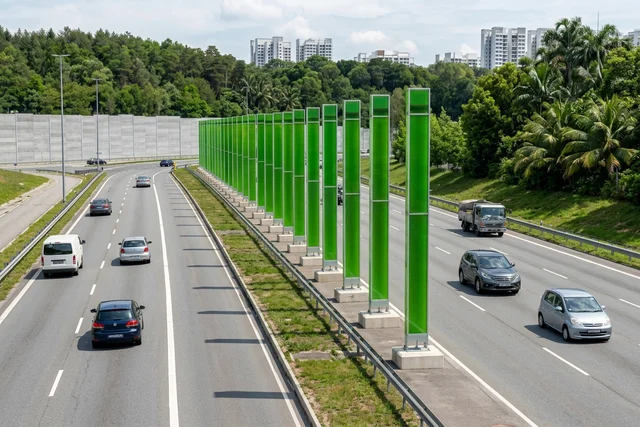
Highways and Roadways
The first large scale installations appear along major expressways and highway medians. These panels capture emissions from heavy traffic directly, maximizing carbon absorption exactly where it matters most.
Because the panels are vertical, they don’t interfere with traffic flow or require expansive land parcels. This vertical integration also makes them suitable for other high‑density parts of the city.
Buildings and Urban Structures
Singapore’s architects and climate tech companies are now exploring how microalgae bioreactors can be integrated into building facades turning skyscrapers into living carbon sinks. Such applications are often called bioreactor facades or photobioreactor walls, and they combine air purification with architectural design. In these systems, transparent panels filled with microalgae are mounted on building exteriors. As air circulates past them, microalgae absorb carbon and produce oxygen, acting like a natural, biological skin for the building.
Public Spaces and Urban Furniture
Beyond highways and buildings, researchers and designers are experimenting with algae technology at bus stops, public benches, and pedestrian areas—bringing more greenery to everyday spaces while also helping purify urban air.
Major Benefits of Vertical Algae Panels
Why is Singapore investing so heavily in these bioreactors? Here are the four main reasons:
- Massive Carbon Capture: A single square meter of algae can absorb as much CO₂ as 15–20 mature trees, making it perfect for our dense urban areas.
- Space-Saving Design: Since they are mounted vertically on building facades and highway barriers, they don’t compete for precious land.
- Urban Cooling Effect: Like traditional plants, these panels help reduce the “urban heat island” effect, keeping Singapore’s streets cooler.
- Zero Waste: The harvested algae is recycled into high-quality bio-fertilizer for Singapore’s vertical farms or processed into biofuel
Algae Panels vs. Trees: A Comparison
Here’s how Vertical Algae Panels in Singapore stack up against traditional trees when it comes to carbon capture and urban benefits:
| Feature | Algae Panels | Trees |
|---|---|---|
| Carbon Capture Rate | High – can absorb many times more CO₂ per m² | Low – slower, decades‑long growth |
| Space Requirements | Vertical installations | Require horizontal space |
| Maintenance | Harvesting biomass, panel upkeep | Pruning, watering, soil management |
| Air Purification | Very high (direct CO₂ to O₂ conversion) | Moderate |
| Economic Outputs | Biofuel, fertilizer, biomass | Primarily ecological benefits |
Algae panels are not meant to replace trees completely but complement them, especially in areas where trees can’t grow or where space is limited. Panels excel at rapid carbon capture and can be part of a broader urban net‑zero strategy alongside traditional green spaces.
The Circular Economy: Turning Captured Carbon Into Value
The most clever part about these panels isn’t just that they clean the air it’s that the waste they produce is actually valuable. In 2026, Singapore is proving that captured carbon can actually pay for itself. Once the algae in the panels becomes thick and saturated, it’s harvested and fed back into the city’s economy.
Where does all that harvested algae go?
Feeding Our Vertical Farms: Instead of importing synthetic fertilizers, Singapore’s high-tech vegetable farms are now using algae-based biostimulants. It’s a perfect loop: urban CO₂ helps grow local salads.
Powering Changi’s Flights: With the 2026 push for Sustainable Aviation Fuel (SAF), the lipids extracted from these highway panels are being processed into renewable jet fuel, helping lower the carbon footprint of our aviation hub.
The Carbon to Credit Model: For building owners, these panels aren’t just filters; they are assets. The captured carbon is being quantified into Carbon Credits, making the initial high cost of installation much easier to swallow.
Challenges of Vertical Algae Panels in Singapore
While the tech is revolutionary, it’s not a plug-and-play solution yet. In 2026, Singapore is still fine-tuning these systems to overcome three main hurdles:
Maintenance and Operations
Keeping a living system healthy requires regular maintenance:
Monitoring algae growth
Ensuring adequate light and nutrients
Periodic biomass harvesting
Advanced systems use automation and sensors to reduce manual intervention, but costs remain higher than passive greenery.
Real Costs of Singapore’s Vertical Algae Panels
The initial setup for a high rise facade is significantly higher than traditional vertical gardening. Building owners in Singapore usually rely on NEA grants or Carbon Credits to make the investment financially viable.
Scalability Of Vertical Algae Panels
Widespread scaling across an entire city requires coordination, regulatory adjustments, and long‑term urban planning. While Singapore’s pilot projects are promising, full integration across all urban zones will take time and investment.
Despite these challenges, cities like Singapore are moving forward, as the environmental benefits far outweigh the limitations, especially with continuous technological improvements.
Singapore’s Garden City is getting a high tech upgrade. Vertical Algae Panels in Singapore aren’t just for show they are the most efficient carbon-capture engines we have in 2026. While the costs and maintenance are real challenges, the ability to turn city pollution into local bio-fertilizer is a game-changer for the Singapore Green Plan 2030.
Next time you see a glowing green facade on an HDB or office tower, remember: it’s not just a decoration. It’s a living lung, working 40 times harder than a tree to keep our urban air clean.
Read more related articles: Urban Farming A Growing Trend In Malmo And Beyond
FAQs
Q1. Do vertical algae panels in Singapore smell?
Ans. No, these are closed-loop pressurized systems. The algae is contained within glass or high-grade polymer panels, so there is zero odor leak into the urban environment.
Q2. How much CO₂ can one panel actually capture?
Ans. On average, a single square meter of an advanced 2026 bioreactor can capture as much CO2 as 15 to 20 mature trees, depending on sunlight exposure and the specific algae strain used.
Q3. Are algae panels better than planting trees?
Ans. They don’t replace trees, they complement them. While trees offer shade and support biodiversity, algae panels capture carbon far more efficiently in tight urban spaces where planting a forest isn’t feasible.