Rising sand temperatures affect the gender balance of hatchlings, while coastal erosion destroys nesting sites. Warmer waters also shift feeding routes, leaving sea turtles vulnerable. By 2026, all six major sea turtle species will be classified as vulnerable, endangered, or critically endangered.
Blog

How Global Warming Is Threatening Marine Life In 2026
Global warming is transforming our oceans faster than ever, & global warming is threatening marine life across every level of the food chain. Rising sea temperatures, melting ice, and ocean acidification are creating conditions that many species cannot survive. In 2026, scientists warn that warming oceans are accelerating biodiversity loss, from coral reefs to large marine mammals. Understanding these impacts is critical to protecting both marine ecosystems and human communities that rely on them.
How Global Warming Is Changing the Ocean
In 2026, oceans are warming at a record pace, absorbing more than 90% of the excess heat trapped by greenhouse gases. This rapid warming is reducing oxygen levels, accelerating ocean acidification, and triggering intense marine heatwaves that now affect most of the world’s seas each year. These prolonged heat events are devastating coral reefs, disrupting fish populations, and placing shell-forming species under severe stress.
As ocean conditions change, many marine species are being forced to migrate away from traditional habitats in search of cooler, oxygen-rich waters. This shift is disrupting feeding and breeding cycles & creating serious challenges for global fisheries that depend on stable ecosystems. At the same time, higher carbon dioxide absorption is weakening coral skeletons and shellfish shells, undermining the very foundation of marine food webs. Scientific evidence in 2026 clearly shows that global warming is actively reshaping the oceans and may permanently change marine life and the overall balance of ocean ecosystems.
Why Oceans Are Most Vulnerable
By 2026, oceans remain the planet’s most vulnerable and critical climate system component because they absorb an overwhelming majority of the heat and carbon dioxide produced by human activities. In 2025, the world’s oceans set a new record for heat absorption, taking in an additional 23 zettajoules of heat—more energy than in any year since modern records began and marking the ninth consecutive year of rising ocean heat content. This massive heat gain reflects the fact that about 90 % of the excess heat trapped by greenhouse gases ends up in the oceans, making ocean heat content one of the clearest measures of climate change.
This rapid warming alters marine habitats faster than many species can adapt. Warmer water holds less oxygen, contributing to expanding low‑oxygen “dead zones” where marine life struggles to survive. Meanwhile, the ocean absorbs nearly a quarter of human-made CO₂ emissions, altering its water chemistry and accelerating ocean acidification, which weakens coral skeletons and the shells of shellfish and other organisms at the base of the food web.
The combination of record heat, declining oxygen levels, and increasing acidity puts oceans on the front line of the climate crisis—impacting everything from coral reefs and fish populations to global food security and coastal economies.
Five Main Threats Facing Marine Ecosystems
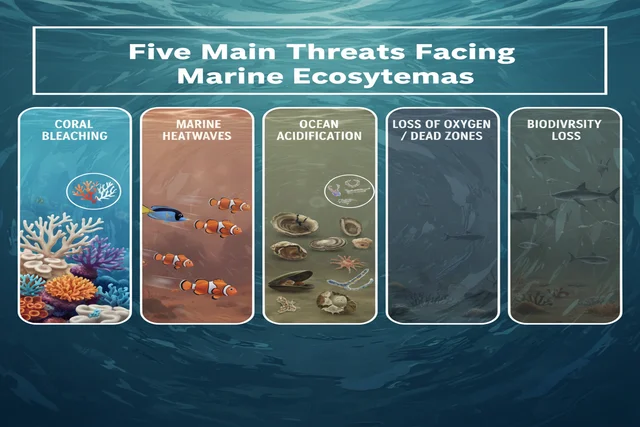
Here are 5 main threats facing the marine ecosystem in 2026:
1. Coral Bleaching
By 2026, coral bleaching has reached unprecedented levels. Rising ocean temperatures are causing more frequent and severe bleaching events, with studies showing that over 84% of the world’s coral reefs have experienced severe thermal stress in recent years. Heat stress forces corals to expel the algae that give them color and energy, leaving them pale and vulnerable. Prolonged bleaching can lead to mass coral die-offs, which devastate marine biodiversity and reduce habitats for countless species. Ocean acidification further weakens coral skeletons, making recovery slower and less likely. These combined threats not only endanger marine life but also affect coastal communities and fisheries that rely on healthy reefs.
2. Ocean Acidification
By 2026, ocean acidification has intensified, with surface waters now about 30% more acidic than pre-industrial levels due to increased CO₂ absorption. This chemical shift reduces the availability of carbonate ions, which are essential for corals, shellfish, and plankton to build strong skeletons and shells. As a result, coral reefs weaken, and foundational species at the base of the marine food web struggle to survive, threatening the stability of entire ecosystems. Acidified waters also impair the growth and reproduction of commercially important shellfish, directly impacting global fisheries and the millions of people who rely on them for food and livelihood. Scientists warn that without urgent action to reduce CO₂ emissions, ocean acidification could permanently alter marine biodiversity
3. Marine Heatwaves and Oxygen Stress
In 2026, marine heatwaves are occurring more frequently and lasting longer than ever before, affecting nearly 96% of the world’s oceans in recent years. These extreme temperature events can raise water temperatures by 2–5°C above normal, stressing fish, plankton, and coral ecosystems. Prolonged heatwaves disrupt breeding cycles, feeding patterns, and migration routes & can trigger mass die-offs of marine species. Coastal fisheries are seeing declining catches as key species migrate to cooler waters, threatening food security for millions of people around the world. Scientists warn that without rapid climate action, these heatwaves will continue to intensify, pushing marine ecosystems toward irreversible change.
4. Loss of Oxygen / Dead Zones
By 2026, global warming is threatening marine life by reducing oxygen levels in oceans at an alarming rate. Warmer waters hold less dissolved oxygen, creating expanding low‑oxygen “dead zones” where many fish, invertebrates, and plankton cannot survive. Recent studies show that the number and size of dead zones have doubled over the past two decades, affecting key regions such as the Gulf of Mexico, the Baltic Sea, and parts of the Pacific Ocean. These oxygen-depleted areas disrupt food webs, force species to migrate, and contribute directly to biodiversity loss. Scientists warn that if greenhouse gas emissions continue unchecked, more than 10% of the world’s oceans could turn into low-oxygen zones by mid-century, making marine ecosystems even more vulnerable and showing more clearly than ever how global warming is threatening ocean life.
5. Biodiversity Loss and Human Consequences
By 2026, global warming is threatening marine life on a large scale, causing biodiversity loss that affects entire ocean ecosystems. Warming waters, acidification, coral bleaching, and expanding dead zones are driving species toward migration, decline, or extinction. Scientists report that over half of marine ecosystems are now degraded, with some regions facing near-total collapse of local populations. This loss of biodiversity directly impacts human communities: fisheries suffer declining catches, coastal livelihoods are disrupted, and food security is at risk for millions worldwide. Protecting marine ecosystems has become critical—not just for wildlife, but for the human populations that depend on them.
Global warming is already altering the world’s oceans, causing rising temperatures, acidification, and oxygen loss that disrupt marine ecosystems and threaten species’ survival. According to the United Nations, these changes are driving coral bleaching, shifting species ranges, and increasing the risk of biodiversity loss worldwide. Protecting ocean health is essential for marine life and the billions of people who depend on it for food and livelihoods.
Species Most Affected by Global Warming in 2026
Blue Whale—The Ocean Giant in Trouble
Blue whales, the largest mammals on the planet, are struggling as warming oceans reduce their availability. With only about 10,000 to 25,000 blue whales left, threats like ship strikes and entanglement in fishing gear are becoming even more dangerous as climate change continues to reduce their food supply.
Sea Turtles—Nesting at Risk
Vaquita—The Edge of Extinction
The vaquita, found only in Mexico’s Gulf of California, has fewer than 10 individuals remaining. Illegal gillnets, habitat disturbance, and warming waters make survival nearly impossible without urgent intervention.
Irrawaddy Dolphin—Losing Its Habitat
The Irrawaddy dolphin lives in rivers of Southeast Asia. Only about 85 individuals remain in the Mekong River. Electric fishing, pollution, and waterway construction, combined with warming water, continue to threaten this species.
Ocean Sunfish
The sunfish is vulnerable because warming oceans reduce jellyfish, its main food source, and threats like drifting fishing nets and plastic pollution put it at risk. While populations are declining, exact numbers are uncertain, though some regions report very low counts.
Relict Rentner (Marine Guinea Pig)
This small marine mammal faces serious threats from pesticide pollution, habitat loss, and rising ocean temperatures. Its skin absorbs toxins easily, showing how global warming and pollution together put marine life at risk across the entire ecosystem.
Protecting Marine Life
Humans can act to prevent further damage. Expanding marine protected areas, enforcing sustainable fishing, reducing plastic pollution, and cutting greenhouse gas emissions are critical. Communities can support these efforts by choosing sustainable seafood, reducing plastic waste, and backing conservation initiatives.
By taking action now, we can ensure that global warming is threatening marine life less severely in the years to come.
Global warming is threatening marine life in both visible and hidden ways beneath the waves. Coral reefs are bleaching, shell-building species are declining, and aquatic ecosystems are destabilizing, affecting biodiversity and human survival alike. Coordinated action—reducing emissions, protecting habitats, and promoting sustainable practices—can help safeguard marine life for the future. The oceans are resilient, but time is limited. Protecting them now ensures a sustainable planet for all species, including humans.
Read more related articles: https://www.climatechallange.com/how-marine-heatwave-are-reshaping-ocean-life/
FAQS
Q1: Can fish adapt to warmer oceans?
Ans. Some species can move to cooler areas, but many cannot relocate quickly enough or are limited by their habitats, resulting in population declines and disruptions throughout the ecosystem.
Q2: How does ocean acidification affect marine life?
Ans. Acidification reduces the ability of shell-building organisms like corals and mollusks to form shells. This disrupts marine food chains, affecting species from plankton to predators.
Q3: Can fish adapt to warmer oceans?
Ans. Some species can migrate to cooler areas, but many move too slowly or are confined by their habitats, causing population declines and disrupting entire ecosystems.
admin
0
Tags :