Solar Geoengineering Can Spraying Particles Really Cool the Earth
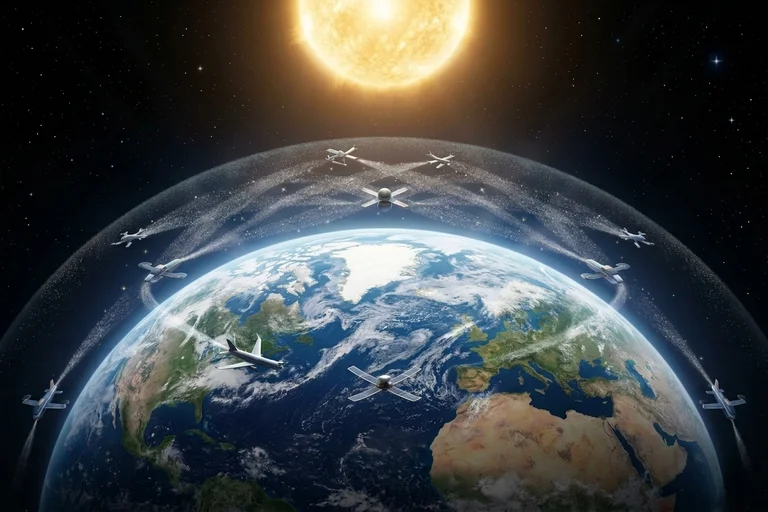
Imagine if we could put a giant sunshade over the Earth to stop global warming. It sounds like science fiction, but solar geoengineering is a very real and very controversial climate strategy. By spraying tiny reflective particles into the upper atmosphere, scientists believe we can bounce sunlight back into space and artificially lower the planet’s temperature. While it offers a potential “emergency brake” for the climate crisis, before we start spraying the sky, we have to ask: are we actually solving the problem or just opening a new risk for the planet?
What is Solar Geoengineering? (Understanding the Albedo Effect)
Solar geoengineering refers to deliberate interventions aimed at reducing the amount of sunlight that reaches the Earth’s surface. You can think of it as placing a giant sunshade over the planet. The main mechanism is the albedo effect, where reflective surfaces bounce solar energy back into space. Ice and snow naturally do this, but geoengineering artificially enhances it.
As polar ice caps melt, Earth loses its natural reflective shield, causing the planet to warm even faster. Solar geoengineering tries to replicate this cooling effect. Scientists propose injecting sulfate aerosols into the stratosphere to form a thin artificial haze. This layer would act like a filter, reflecting some sunlight into space and reducing the amount of heat that reaches the ground.
You can think of it as a controlled version of a volcanic eruption. When Mount Pinatubo erupted in 1991, it released large amounts of sulfate aerosols into the atmosphere, which reflected sunlight and cooled the planet by about 0.5°C for over a year. Scientists are now exploring whether we can recreate this effect deliberately, without the destruction caused by a volcano.
How Does Spraying Particles Cool the Earth? (The Science of SAI)
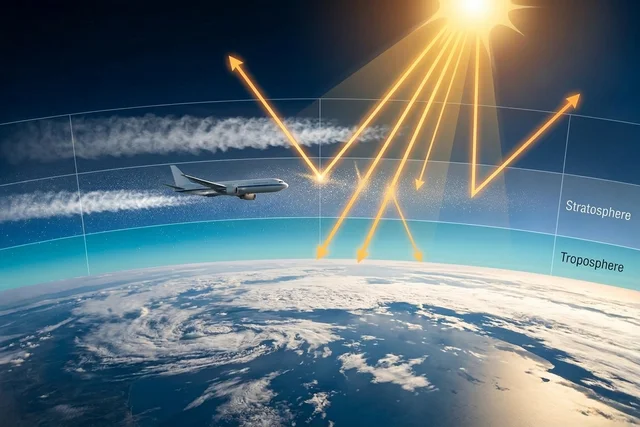
Spraying particles into the sky might sound like a simple fix, but the actual process known as Stratospheric Aerosol Injection (SAI) requires careful balance. Scientists aim to release reflective particles into the stratosphere, about 20 km above the ground, where they can spread around the globe and scatter incoming sunlight back into space.
While this idea draws inspiration from the 1991 eruption of Mount Pinatubo, scientists are now exploring alternatives to volcanic sulfur. Recent 2025 studies from institutions like the University of Cambridge are exploring novel materials such as diamond dust or calcium carbonate, which could potentially cool the planet with fewer side effects on the ozone layer than traditional sulfur.
Key Factors for a Successful Cool Earth:
Particle Engineering: It’s not just about spraying; it’s about the size and shape. If particles are too big, they fall too fast; if they are too small, they don’t reflect enough light.
The Marine Cloud Connection: A 2025 NOAA report suggests that these particles don’t just reflect light themselves; they can also make clouds below them brighter, doubling the cooling effect.
The Commitment Issue: Unlike a volcano, SAI requires a continuous, multi decade effort. If we suddenly stopped a scenario scientists call termination shock, the planet could face decades of trapped warming all at once.
SAI is an emergency brake, not a cure. It can temporarily stop the heat, but it doesn’t remove a single molecule from our atmosphere.
Can Solar Geoengineering Truly Stop Global Warming?
The short answer is no. While solar geoengineering, also known as Solar Radiation Management (SRM) can act as a powerful fever reducer for the planet, it does not address the root cause: the buildup of greenhouse gases in the atmosphere.
You can think of it like taking a painkiller for a broken leg; the pain may go away, but the injury is still there. That’s why scientists at the Intergovernmental Panel on Climate Change warn that we cannot rely on it as a long term solution.
The Ocean Acidification Crisis: Even if we cool the air, the massive amounts of CO2 already in our atmosphere will continue to dissolve into the oceans. This makes seawater more acidic, bleaching coral reefs and destroying marine life a process that “reflecting sunlight” does absolutely nothing to stop.
Regional Winners and Losers: Cooling isn’t a “one size fits all” solution. 2026 climate simulations suggest that while the US or Europe might cool down, certain parts of Africa and South Asia could see their monsoon patterns disrupted, leading to catastrophic droughts or shifts in rainfall that could collapse local agriculture.
The Termination Shock Risk: The concept of termination shock represents one of the biggest risks in climate engineering. If a global Stratospheric Aerosol Injection (SAI) program were suddenly stopped, whether due to war, a cyberattack, or political conflict, the warming it had been masking would return all at once. As a result, the planet could experience decades of warming within a single decade, creating a rapid temperature spike that most species would struggle to adapt to.
The verdict is clear: solar geoengineering is a temporary bridge, not a long-term solution. It may take us 10 to 20 years to scale up carbon capture and renewable energy, but if we fail to reduce emissions, we will only delay a much larger disaster.
The Potential Risks and Side Effects of Cooling the Planet
While cooling the Earth sounds like a win, messing with the stratosphere is like performing surgery on the planet without a full map. Here is what keeps scientists up at night:
The Ozone Layer Gamble:
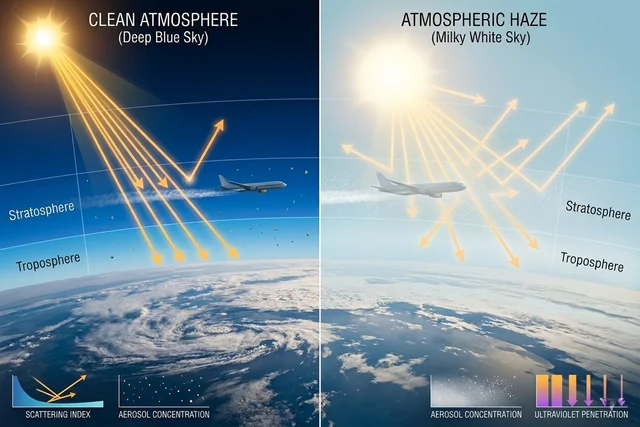
Some studies suggest that sulfate aerosols could trigger chemical reactions that thin the ozone layer. If we damage this protective shield while trying to cool the planet, we could trade global warming for a massive increase in harmful UV radiation.
Disrupting the Global Water Cycle:
This is perhaps the biggest risk for the Global South. Artificially cooling the planet changes how ocean water evaporates, which could disrupt monsoon patterns in South Asia and Africa, potentially causing crop failures that affect billions of people.
A Milky White Sky:
Climate models from 2026 show that because these particles scatter sunlight, our deep blue skies could take on a hazy, milky-white appearance. We might lose the crisp horizons we’ve known for centuries.
The Ethical Dilemma: Man Made Intervention in Earth’s Natural Systems
Beyond the science, we face a profound moral question: do we really have the right to manipulate the planet on such a massive scale?
- The Moral Hazard: Critics warn that if we discover a cheap way to cool the Earth, major polluters might abandon the hard work of cutting emissions. It’s like taking a weight-loss pill while still eating junk food; it masks the problem but doesn’t solve it.
- Geopolitical Conflict: If one country begins spraying particles and another suffers a drought as a result, who is responsible? Without a global governance framework, such as a UN treaty, solar geoengineering could spark weather wars between nations.
- Termination Shock: We are passing a huge burden to future generations. If a geoengineering program is suddenly halted due to war or technical failure, all the “masked” heat would hit the planet at once, causing decades of warming in just a few years.
Current Global Research and Real World Experiments (2026 Update)
Solar geoengineering is moving fast. It is no longer just a theory discussed in labs. By early 2026, research will have shifted to real-world monitoring and high altitude tests.
Moving Beyond Sulfur: The Search for Safe Particles
Original plans focused primarily on sulfur. However, studies from 2025 to 2026 at ETH Zurich point to better alternatives. Scientists are now experimenting with calcium carbonate and even diamond dust. These materials reflect sunlight efficiently and, most importantly, are less likely to harm the ozone layer. This shift marks a significant milestone in climate engineering.
The Arctic Cooling Initiative
A large international project is currently monitoring the Arctic. Rather than attempting to cool the entire planet, researchers aim to target specific regions, with the goal of stabilizing melting permafrost. This localized approach is considered a safer first step, allowing scientists to measure the effects without endangering global weather patterns.
AI Powered Climate Simulations
Technology is playing an increasingly important role. Scientists now use AI-powered digital twins of the Earth, running millions of scenarios every day. These models draw on data from NOAA to predict changes in rainfall and other climate patterns. For example, they can forecast how injecting aerosols over the Pacific might impact crops in South America. This level of detail would have been impossible just five years ago.
The Global Governance Gap
Despite technical progress, a legal problem remains. There is still no international treaty for the sky. In 2026, the Global Commission is calling for more transparency. They want a non use agreement until rules are set. Without these rules, geoengineering could lead to political tension between nations.
Solar geoengineering is a powerful but risky tool. It acts like a temporary emergency brake for our warming planet. However, it is not a permanent cure for climate change. We must remember that Solar Radiation Management (SRM) only masks the heat. It does not remove the greenhouse gases already in our atmosphere.
A Bridge to Carbon Capture
Most experts see this technology as a bridge. It buys us crucial time to scale up carbon capture and renewable energy. If we rely only on spraying particles, we risk a termination shock. This could lead to a massive, sudden temperature spike for future generations.
Final Verdict: Proceed with Caution
In 2026, the global community remains divided. Any move toward geoengineering requires international laws and extreme caution. Our goal is to protect the Earth, not to create new disasters.
Read more related articles: https://www.climatechallange.com/do-trees-release-electric-sparks-in-thunderstorms-study-reveals/
FAQs
Q1. Is solar geoengineering currently being used?
Ans. No, it is not used on a global scale yet. Scientists are only conducting small, localized research. Most 2026 projects are still in the monitoring phase to ensure safety.
Q2. Does it stop ocean acidification?
Ans. No, it does not. This is a major risk. Since it doesn’t reduce, the oceans will continue to absorb carbon. This means marine ecosystems will still face danger.
Q3. What happens if we stop spraying particles?
Ans. If we suddenly stop, the planet faces “Termination Shock.” All the trapped heat would hit the atmosphere at once. This could cause decades of warming to happen in just a few years.