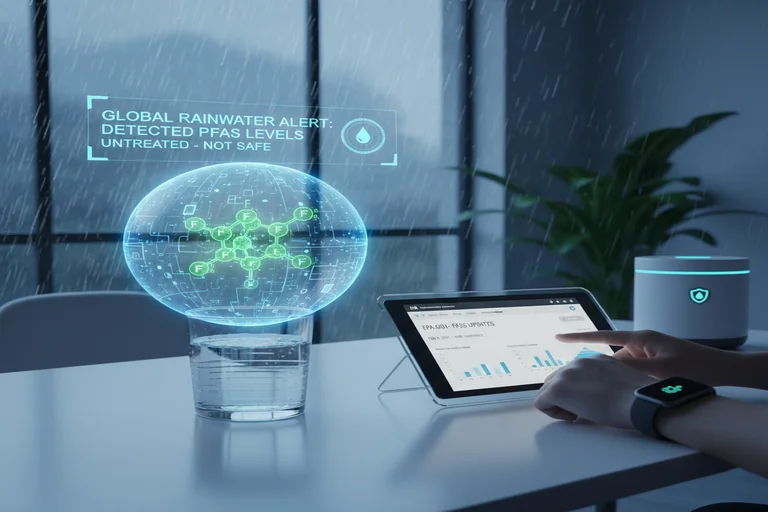
PFAS In Rainwater Is It Still Safe To Drink In 2026
For centuries, we’ve looked at rain as the purest form of water, a gift from the sky that fuels life and offers a free resource for off-grid living. But as we move through 2026, that romantic image has officially shattered. The reality is harsh: PFAS in rainwater has turned a natural blessing into a chemical hazard.
Whether you are harvesting rain in the remote mountains of Tibet or a suburban backyard in the US, the water falling from the clouds is no longer clean.Recent environmental shifts and updated global health advisories have confirmed that the era of drinking raw natural water sourcesis over. We aren’t just dealing with a bit of dust or bacteria anymore; we are dealing with a permanent chemical footprint that has rewritten the rules of survival and sustainability.
What Are Forever Chemicals? (The PFAS Threat)
To understand why this is a crisis, you need to know what you’re up against. PFAS (per-and polyfluoroalkyl substances) are better known as forever chemicals. This isn’t just a catchy nickname; it describes a scientific nightmare.
These man-made chemicals are built on a carbon-fluorine bond, one of the strongest bonds in organic chemistry. Because of this molecular super glue, PFAS do not break down in the environment, the soil, or your bloodstream. They’ve been used since the 1940s in everything from non-stick pans to firefighting foams and waterproof gear.
These chemicals cause serious problems: They leak, they migrate, and most importantly, they persist. In 2026, we are witnessing the cumulative impact of decades of industrial neglect. Instead of remaining contained in landfills, these chemicals enter the water cycle and stay there indefinitely.
Atmospheric Cycling of PFAS in Rainwater
A common misconception is that living far from industrial hubs guarantees safety from chemical exposure. However, research conducted by Stockholm University has demonstrated that PFAS per- and polyfluoroalkyl substances) are globally ubiquitous. Through a process known as atmospheric cycling, these chemicals are transported from ocean spray and industrial sites into the atmosphere.
Once airborne, PFAS can travel thousands of miles, eventually falling as precipitation. This explains why researchers have detected these substances in remote areas like Antarctica and the Tibetan Plateau. The Environmental Protection Agency (EPA) and other global environmental bodies continue to monitor how these “forever chemicals” move through the global water cycle, noting that their persistence makes them a long-term environmental challenge.
PFAS in Rainwater: Global Health Implications and the 2026 Guidelines
For decades, environmental scientists warned us about a “planetary boundary” for chemical pollution. In 2026, we will have officially crossed it. The latest global studies, building on the landmark research from Stockholm University, confirm a terrifying reality: there is no longer any place on Earth, no matter how remote,e where natural water falls within “safe” drinking limits.
The Shift: Then vs Now
The reason 2026 feels like a crisis is that our understanding of “safety” has fundamentally changed.
- The Old Standard: A few years ago, regulators measured safety limits for chemicals like PFOA in parts per billion (ppb). At that time, people believed these small amounts would not cause serious harm.
- The 2026 Reality: By 2026, the reality has changed. New EPA mandates and updated European Food Safety Authority (EFSA) guidelines have cut these limits to nearly zero. Safety is now measured in parts per trillion (ppt). To put this into perspective, one part per trillion is about the same as a single drop of water in 20 Olympic-sized swimming pools.
Why No Place is Safe
Even in the pristine heights of the Himalayas or the vast wilderness of the Arctic, rainwater samples in 2026 consistently exceed these new, stricter guidelines. This is the tipping point.Because PFAS are so persistent in the atmosphere, they have become a permanent part of the Earth’s weather cycle. Scientists now warn that the “background levels” of these chemicals in the atmosphere are higher than the levels allowed in our drinking water.
In effect, the sky itself has become a constant source of low-level chemical exposure. This is no longer just an industrial issue; it has turned into a global environmental baseline that every human, animal, and plant must now live with.
Why Traditional Water Tests are Failing to Detect Forever Chemicals
If you think your handheld TDS (Total Dissolved Solids) meter or a standard $20 home test kit can tell you if your atmospheric pollutantsis safe, you are unfortunately mistaken. In 2026, one of the biggest hurdles in the PFAS crisis is the invisibility of the threat.
The TDS Illusion
A TDS meter estimates mineral and salt levels by measuring the electrical conductivity of water. PFAS, however, are micro-contaminants that exist at extremely low concentrations, often in parts per trillion (ppt).
A TDS meter is designed to detect parts per million (ppm), not these trace chemicals. As a result, your meter may show a (000) reading and create a false sense of safety, even though the water may still contain harmful levels of PFOA or PFOS.
The Need for Specialized Labs
Standard water tests provided by most local municipalities or basic hardware stores usually look for bacteria (like E. coli), lead, or nitrates. They completely overlook (forever chemicals) because the equipment needed to detect them is extremely expensive and highly sophisticated.
To find PFAS, a laboratory must use a process called LC-MS/MS (Liquid Chromatography with Tandem Mass Spectrometry). According to the American Council of Independent Laboratories (ACIL), only specialized facilities with high resolution equipment can accurately quantify these compounds at the levels now required by the EPA.
Forever Chemicals and Your Health Risk
The primary concern regarding PFAS (per and polyfluoroalkyl substances) in 2026 involves their bioaccumulative nature. Unlike many toxins that the liver and kidneys flush out, PFAS can remain in human blood and organs for extended periods. Clinical data suggest these chemicals have a half-life in humans that spans several years.
When consumed over a long period, even in microscopic amounts, exposure can lead to several systemic health issues:
- Immune System Suppression: Research suggests that these toxic molecules can weaken the immune response. In children, some studies have indicated a potential link to decreased vaccine effectiveness.
- Hormonal Disruption: PFAS are often categorized as endocrine disruptors. They can mimic natural hormones, which may lead to thyroid complications and impact fertility.
- Metabolic and Liver Impact: Exposure levels have been linked to increased cholesterol levels and altered liver enzyme functions in some individuals.
- Carcinogenic Risks: Organizations like the International Agency for Research on Cancer (IARC) have classified specific hazardous pollutants, such as PFOA, as carcinogenic to humans.
The health risk is generally associated with chronic buildup rather than immediate poisoning. This makes understanding prevention and the efficacy of different filtration methods a critical part of managing exposure.
Why 2026 Homeowners are Struggling
The gap between public awareness and access to proper testing has never been wider. Unless you specifically request a synthetic chemicals-focused test from a certified environmental lab, you are essentially flying blind. For off grid communities that rely on water supply, this makes the old smell, taste, and basic test approach completely obsolete.
Is Your Rainwater Safe for Gardening? Understanding PFAS in Rainwater
Since drinking raw rainwater is now a high risk activity, many people ask, Can I at least use it for my organic garden?
The answer in 2026 is complicated. While plants do not absorb toxic molecules at the same rate as humans, research shared by the USDA (United States Department of Agriculture) and various environmental studies suggests that “bioaccumulation” is a real concern.
Using rainwater for gardening in 2026 presents risks due to PFAS bioaccumulation in soil and absorption by plants, particularly leafy greens. Gardeners may consider using carbon-filtered rain barrels or periodically testing soil to mitigate these concerns.
- Soil Retention: PFAS don’t just wash away. They stick to the organic matter in your soil. Over the years of watering with contaminated rain, the concentration in your garden bed can actually increase.
- Leafy Greens vs Fruit: Studies show that leafy greens (like spinach and kale) are more likely to take up these chemicals into their tissues compared to fruiting plants like tomatoes or peppers.
- Livestock Warning: If you use rainwater for chickens or goats, keep in mind that synthetic chemicals can pass into eggs and milk. Several agricultural health reports in recent years have documented this transfer.
For a truly organic lifestyle in 2026, even your garden irrigation needs a filtration strategy.
How to Filter and Remove PFAS from Your Rainwater
In 2026, standard filtration is no longer enough. The most critical rule to remember: Boiling water does not remove these contaminants. In fact, boiling evaporates the pure water, leaving a higher, more toxic concentration of synthetic chemicals behind.
To effectively eliminate (forever chemicals), you need specialized technology:
- Reverse Osmosis (RO): This remains the most effective residential solution, capable of stripping away up to 99% of toxic molecules.
- Certified Carbon Filtration: Only use filters with NSF/ANSI 53 or P473 certification. These use granular activated carbon to trap the chemicals.
- Ion Exchange: These systems use specialized resins to attract and bind PFAS ions, removing them from the water stream entirely.
For verified performance, always check the NSF International database to ensure your system is rated for PFOA and PFOS removal.
The presence of PFAS in rainwater has fundamentally changed how we view natural water sources in 2026. Although rain is no longer naturally pure, we can still use rainwater by adopting advanced filtration methods such as reverse osmosis (RO) and activated carbon. Staying informed through resources like the EPA’s contaminants updates is no longer just for scientists; it has become an essential skill for modern survival. In 2026, protecting your health means looking at the clouds with a critical eye and a solid filtration plan.
Read more related articles: https://www.climatechallange.com/how-dna-research-unlocking-the-hidden-half-of-plants/
FAQS
Q1. Can we boil PFAS out of rainwater?
Ans. No, boiling water does not remove PFAS. In fact, boiling can slightly increase the concentration of these chemicals as some water evaporates, leaving the hazardous pollutants behind. You need advanced filtration like Reverse Osmosis (RO).
Q2. What is the safe limit for PFAS in drinking water in 2026?
Ans. Regulatory bodies like the EPA have significantly lowered the health advisory levels, often aiming for near-zero PPT (parts per trillion) for specific compounds like PFOA and PFOS.
Q3. How do you remove PFAS from groundwater?
Ans. Research shows that three main treatment methods can effectively remove PFAS: granular activated carbon, ion exchange resins, and high-pressure membrane systems. Selecting the most suitable option depends on carefully considering several different factors.