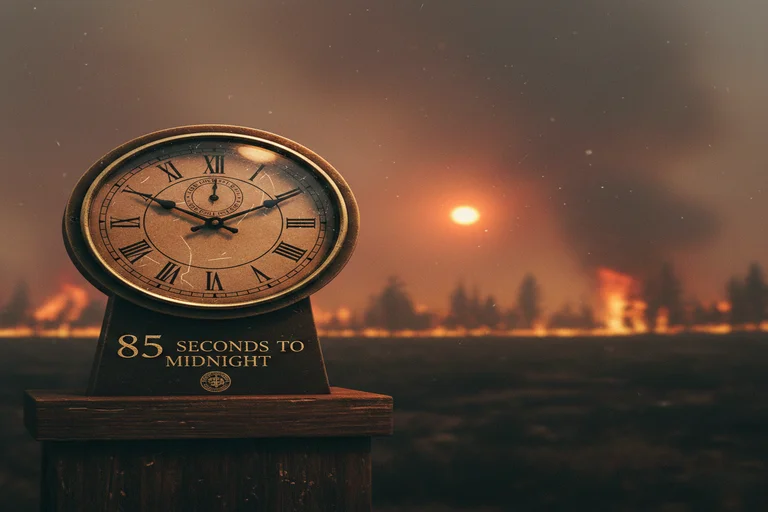
Doomsday Clock 2026 85 Seconds To Midnight Alert Explained
The year 2026 has brought us face-to-face with a chilling reality: we are now just 85 seconds away from midnight. This latest update to the Doomsday Clock 2026 is not just a symbolic gesture; it is an urgent scientific alarm for humanity. While the world’s top experts and Nobel laureates have monitored various global threats, the primary driver for this year’s countdown is the undeniable climate challenge we are currently facing.
Following a year of record-shattering heatwaves and unprecedented environmental shifts in 2025, the data suggests we are approaching a critical tipping point. The clock is ticking louder than ever, but what specifically triggered this move, and is it still possible to turn back the hands of time? In this article, we break down the science and the reality behind the most dangerous 85 seconds in history.
Understanding The History of the Clock: From 1947 to 2026
Since its creation in 1947 by the Bulletin of the Atomic Scientists, the Doomsday Clock has served as a powerful reminder of our planet’s vulnerability. Originally, scientists designed it to warn the public about the looming threat of nuclear war. Today, the scope has expanded. Every year, a Science and Security Board made up of the world’s top experts and Nobel Laureates meticulously reviews global dangers, ranging from nuclear proliferation to the rapid acceleration of climate change and unregulated AI.
On this symbolic clock, midnight represents the ultimate global catastrophe. The closer the hands move toward midnight, the higher the risk to human civilization. While the clock itself is a metaphor, the data driving it is very real. For the Doomsday Clock 2026, these settings reflect scientifically measured threats in geopolitics and environmental stability that demand our immediate attention.
Doomsday Clock 2026: Scientists Set New Time
The Doomsday Clock 2026 announcement has officially set the time at 85 seconds to midnight—marking the most dangerous moment in human history.This isn’t just a random number; scientists moved the hands based on several serious threats that are happening all at once:
- Nuclear Dangers: Tensions between the world’s biggest powers are at a boiling point, making the risk of conflict higher than ever.
- The AI Risk: New technologies like Artificial Intelligence (AI) are advancing so quickly that we don’t yet have adequate rules to keep them safe.
- Lack of Global Cooperation: Instead of working together, countries are becoming more divided, which makes it harder to solve big problems.
- Climate Change: The planet is heating up faster than predicted. Rising temperatures and extreme weather are not just environmental issues anymore; they are causing food shortages and fighting over resources.
The Bulletin of the Atomic Scientists made it clear: the Doomsday Clock 2026 reflects a world in crisis. To stay safe, we can no longer ignore how these problems are connected.
The Science Behind 85 Seconds: The 2025 Climate Crisis
Climate change has been a core factor in the Clock’s decisions since the early 2000s. Scientific data show that the past decade has experienced record-breaking heat and accelerated ice melt, placing humanity at a critical crossroads.
Global Heat and Greenhouse Gases
The year 2025 was officially one of the three hottest years ever recorded. During this time, global temperatures stayed dangerously high, far above the levels seen before the industrial age. Our oceans also felt the heat, absorbing record amounts of excess energy trapped by greenhouse gases.
At the same time, carbon dioxide (CO₂) levels in our atmosphere hit a new peak, crossing 428 ppm (parts per million) in January 2026. Other harmful gases like methane and nitrous oxide are also rising fast, disrupting weather patterns across the globe. The IPCC and NASA confirm that human activity is the main driver of these changes, leading to severe damage to our ecosystems and water supplies.
Arctic Decline and Ice Melt
- Shrinking Sea Ice: Arctic ice is disappearing at an alarming rate. This means the Earth is losing its natural “mirrors” that reflect sunlight, causing the planet to heat up even faster.
- Retreating Glaciers: Glaciers worldwide are melting faster than scientists predicted. This is causing sea levels to rise and threatening the freshwater supply for millions of people.
- Extreme Weather: We are seeing more frequent and intense heatwaves, wildfires, and floods. These aren’t just weather events; they are direct threats to our global security.
These climate shifts make the world more vulnerable to conflicts over resources and economic instability. All of these factors played a huge role in the Doomsday Clock 2026 announcement of 85 seconds to midnight.
Historical Perspective: 1991 vs 2026
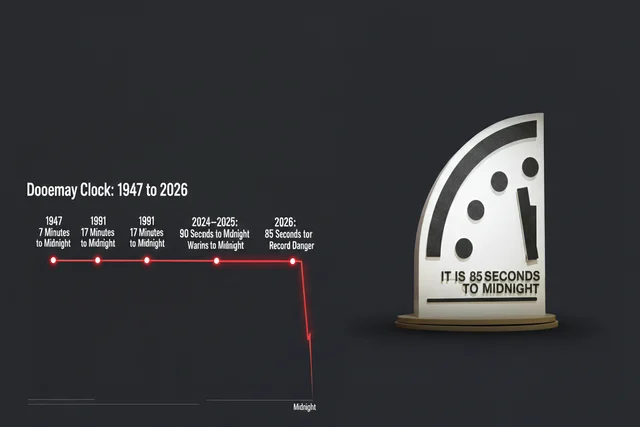
In 1991, the Doomsday Clock 1991 was at 17 minutes to midnight, the farthest point from global catastrophe in its history. This occurred after the Cold War ended and major nuclear disarmament treaties were signed. At that time, optimism about international cooperation and peace prevailed.
However, the Doomsday Clock 2026 shows a much darker reality. Over the last 30 years, we have moved dangerously closer to the brink:
- 1947: When the clock first started, it was at 7 minutes to midnight.
- 1991: The safest year ever recorded, at 17 minutes away.
- 2024–2025: The time was held at 90 seconds as a major warning sign. In reality, the clock was set to 90 seconds in January 2024 and stayed there throughout 2025.
- 2026: We are now at a record-breaking 85 seconds to midnight.
Climate as a Threat Multiplier
Climate change exacerbates existing global risks:
- Resource scarcity: Droughts and heat stress create competition for water and food.
- Social instability: Extreme weather events displace populations and disrupt societies.
- Conflict amplification: Stressed nations and communities are more prone to conflict.
- Economic disruption: Climate-induced losses can destabilize economies and amplify global tension.
By worsening these conditions, climate change acts alongside nuclear proliferation and technological threats, reinforcing why the Doomsday Clock 2026 is set so close to midnight.
The Bulletin of the Atomic Scientists:
The Science and Security Board is responsible for deciding the Clock’s time each year. This board is made up of top experts who evaluate a complex web of risks, including.
- Nuclear Weapons: Analyzing arms control treaties and global nuclear stockpiles.
- Climate Science: Reviewing the latest greenhouse gas data and global temperature trends.
- Emerging Technologies: Assessing the risks of unregulated AI and new biological threats.
- Geopolitics: Monitoring international stability and the extent to which world leaders are cooperating or failing to do so.
Their evaluation is strictly driven by science. They integrate verified data to provide a realistic look at our world’s safety. The 2026 decision the gloomiest in the clock’s history reflects the highest perceived risk to humanity since 1947.
Can We Turn Back the Clock?
While 85 seconds to midnight sounds terrifying, the clock is a warning not a final sentence. History shows we can move the hands back. To do this in 2026, we need immediate action:
- Rapid Green Energy Shift: Countries must move away from coal and oil faster than ever.
- Global Diplomacy: Leaders need to sign new treaties to reduce nuclear risks.
- Responsible AI: We must create global rules to ensure AI is used for the planet’s benefit, not destruction.
If we take these steps, the Doomsday Clock prediction for 2026 could show that we are actually moving away from the brink next year.
The Doomsday Clock 2026 announcement of 85 seconds is a wake-up call for every person on Earth. It reminds us that our climate, our technology, and our politics are all connected. We are living in the most dangerous time in human history, but we also have the most tools to fix it. The ‘Climate Challenge’ is no longer a future problem it is the fight of our lives, right now.
Read more related articles: https://www.climatechallange.com/why-2025-is-ranking-among-the-warmest-years-record-in-history/
FAQS
Q1: What is the history of the Doomsday Clock’s safest time?
Ans. The clock reached its safest point in history in 1991, when it was set to 17 minutes to midnight. According to the official archives of The Bulletin of the Atomic Scientists, this happened because the Cold War officially ended and major nations signed historic nuclear disarmament treaties. It remains the only time in history when humanity felt truly distant from a global catastrophe.
Q2. What happens when the Doomsday Clock hits midnight?
Ans. In the scientific and symbolic world of the Bulletin, hitting midnight represents a “point of no return” or a total global catastrophe.This could mean the start of a large-scale nuclear war or a complete collapse of the Earth’s climate system that humanity cannot fix. Scientists use this metaphor to warn that reaching midnight would place the survival of human civilization, as we know it, at extreme risk.
Q3: Why is the Doomsday Clock 2026 set so close to midnight?
Ans. The Doomsday Clock 2026 is set at 85 seconds because of what experts call “compounded risks.” The Bulletin’s Science and Security Board highlighted that the record-breaking global heat of 2025, combined with failing international diplomacy and the rise of unregulated AI, has created the most dangerous environment in history. Essentially, we are facing too many crises at once without enough global cooperation to solve them.