Environmental Impact Of U.S. Data Centers 2025 Facts And Figures
The environmental impact of U.S. data centers is no longer a future concern—it is a present‑day reality shaping energy systems, water resources, and climate policy in 2025. From cloud storage and streaming to artificial intelligence and daily online services, data centers quietly power modern life. But behind that convenience is a fast‑growing physical footprint that demands electricity, water, land, and constant cooling.
In 2025, the expansion of AI‑driven computing has pushed U.S. data centers into the spotlight. Communities, utilities, and policymakers are now asking harder questions: How much power do these facilities really use? What does that mean for emissions and water supplies? And can efficiency and clean energy keep pace with growth? This article breaks down the facts and figures shaping the debate this year.
Understanding the Environmental Impact of U.S. Data Centers in 2025
Data centers are large facilities filled with servers that store, process, and transmit digital information. While they have existed for decades, their role has changed dramatically in recent years.
In 2025, artificial intelligence will be the biggest driver of data center growth. Training and running AI models need tremendous computing power—far more than traditional web hosting. When you add cloud services, video streaming, remote work, online shopping, and financial systems, the demand for data center capacity becomes continuous and relentless.
Most new facilities are “hyperscale” data centers—massive buildings designed to support global platforms. These sites operate 24/7, require high‑reliability electricity, and must be cooled continuously, regardless of weather conditions.
Electricity Use: How Much Power Do U.S. Data Centers Consume in 2025
Electricity consumption remains the most visible part of the environmental impact of U.S. data centers.
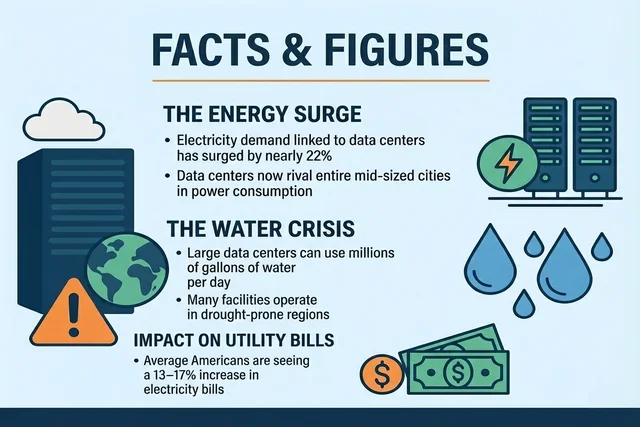
By 2025, U.S. data centers are estimated to use around 180 terawatt‑hours (TWh) of electricity per year, roughly 4% of total U.S. electricity demand. To put that into perspective, this is more power than many entire countries consume annually.
What matters even more than today’s number is the trend. Demand has been rising sharply, and forecasts suggest data centers could account for 6–12% of U.S. electricity use by the end of the decade if current growth continues.
This surge puts pressure on local power grids, especially in regions with heavy clustering such as Northern Virginia, Texas, Arizona, and parts of the Midwest. In some areas, utilities are delaying the retirement of fossil-fuel plants or approving new gas capacity to meet data center demand. For more information about the energy use of U.S. data centers and policy recommendations, according for more U.S. Department of Energy report.
Carbon Emissions: A Growing Climate Footprint
Electricity use directly links data centers to greenhouse gas emissions. While many operators purchase renewable energy credits, the actual electricity flowing into facilities often comes from regional grids that still rely heavily on fossil fuels.
In 2025, U.S. data centers are responsible for over 100 million metric tons of CO₂ emissions annually, representing more than 2% of total U.S. emissions. This places them on par with major industrial sectors.
Efficiency improvements have helped data centers use energy more effectively and reduce emissions for each unit of computing. However, total greenhouse gas emissions continue to rise because overall demand for data center power is growing even faster than efficiency gains can offset. In regions where coal or natural gas still dominate the electricity grid, data centers tend to drive even higher climate impacts, since the emissions associated with each kilowatt-hour of electricity remain high on those fossil-fuel-heavy grids.
This gap between corporate climate pledges and real‑world grid emissions has become a key point of criticism from environmental groups.
Water Use: The Hidden Environmental Cost
Water is often overlooked in conversations about digital infrastructure, yet it plays a critical role in data center cooling.
In 2025, U.S. data centers directly consume tens of billions of gallons of water each year. Much of this water is used in evaporative cooling systems designed to prevent servers from overheating.
The concern is not just volume, but location. Many new facilities are being built in water‑stressed regions, where communities already face drought risks. During heatwaves, data centers may increase water use at the same time residents are asked to conserve.
Beyond direct use, there is also indirect water consumption associated with electricity generation, particularly from thermal power plants. When these factors are combined, the true water footprint becomes even larger.
Local Environmental and Community Impacts
The costs of data center expansion are increasingly being felt by everyday electricity users.
Utility Bill Hikes and the Cost Passed to the Public
In major data center hubs such as Virginia and Texas, residential electricity customers have seen utility bills rise by an estimated 13–17% in recent years. Regulators and consumer advocates point out that a significant share of these increases is linked to grid upgrades required to serve large data center loads. New transmission lines, substations, and backup capacity are often funded through rate hikes that affect households and small businesses. This has sparked growing public concern that the financial burden of powering data centers is being shifted onto communities that receive limited direct benefits from these facilities.
The environmental impact of U.S. data centers is often felt most strongly at the local level.
Large data centers can put significant strain on local infrastructure, often requiring new substations, transmission lines, and backup power systems. When facilities rely on diesel generators for emergency or backup power, these generators can release pollutants into the air, worsening local air quality—a concern that is especially acute in communities already burdened by industrial or traffic-related pollution.
Noise pollution from data center cooling systems and backup generators is becoming an increasing concern, particularly in areas where these facilities are located near residential neighborhoods. Although building data centers can generate construction jobs, the facilities typically employ only a small number of staff once they are operational, prompting questions about the long-term economic benefits for the surrounding communities.
Efficiency Gains: Are Data Centers Getting Greener?
To be fair, data centers today are far more efficient than those built a decade ago. Metrics like Power Usage Effectiveness (PUE) have improved steadily, meaning less energy is wasted on cooling and overhead.
Advanced cooling techniques, AI‑driven energy management, and custom‑designed chips all help reduce energy use per computation. Some facilities now reuse waste heat or experiment with liquid cooling systems.
However, in 2025, the core problem remains scale. Even as individual servers become more efficient, the total number of servers and the intensity of workloads continue to rise. Efficiency is helping, but it is not enough to offset growth.
Renewable Energy and Corporate Climate Claims
In 2025, electricity shortages and grid congestion pushed several major technology firms to reconsider nuclear power as a long-term solution. The most widely discussed case involves Microsoft-linked power agreements connected to the Three Mile Island site, where efforts are underway to bring legacy nuclear infrastructure back into service. For tech companies, nuclear energy offers constant, carbon-free electricity that can run data centers around the clock.
However, critics warn that reviving aging reactors raises safety, waste management, and regulatory concerns. This nuclear pivot reflects how severe the power demand from data centers has become, forcing companies to look beyond renewables to maintain uninterrupted operations.
Major technology companies often highlight renewable energy investments as proof that data center growth can be sustainable.
Many data center operators sign long-term contracts for wind and solar power, which help finance new renewable energy projects. On paper, this can make a company appear “carbon neutral.”
The reality, however, is more complicated. Renewable energy isn’t always available when data centers need electricity most, such as during periods of peak demand or extreme weather. In those moments, fossil fuel plants often step in to fill the gap.
This disconnect between renewable energy credits and the actual electricity flowing to data centers has sparked debate over whether current accounting methods truly capture their environmental impact.
Policy Pressure and Calls for Regulation
The December 2025 Moratorium Demand
In December 2025, more than 230 environmental and public-interest organizations, led by Food & Water Watch, formally urged the U.S. Congress to impose a temporary moratorium on new data center construction. The groups warned that the pace of expansion is outstripping environmental oversight, grid capacity, and water planning, especially in regions already under stress.
According to the coalition, unchecked data center growth is increasing electricity demand, prolonging fossil-fuel use, and intensifying water consumption in vulnerable communities. They argued that a pause is necessary to establish stronger federal standards, transparent reporting, and safeguards before approving further large-scale facilities, framing the issue as a national environmental and infrastructure challenge rather than a purely private industry matter.
By 2025, data centers have become a policy issue, not just a technical one.
Environmental organizations and community groups are calling for stronger oversight, including limits on water use, stricter emissions reporting, and requirements for grid‑aligned clean energy. Some regions have even considered temporary pauses on new data center approvals until infrastructure planning catches up.
At the federal level, discussions now focus on how to balance digital growth with climate goals, grid reliability, and environmental justice.
Looking ahead, the environmental footprint of data centers will depend on choices made now. Smarter siting decisions, better integration with renewable energy, water‑efficient cooling, and transparent reporting could all reduce harm.
At the same time, unchecked expansion risks locking in higher emissions and resource use for decades. In 2025, the environmental impact of U.S. data centers stands at a crossroads between innovation and responsibility.
Read more related articles: https://www.climatechallange.com/human-impact-on-the-environment-8-major-activities-and-their-effects/
FAQS
Q1. How much electricity do U.S. data centers use in 2025?
Ans. In 2025, U.S. data centers consume roughly 180 terawatt-hours of electricity per year, which is about 4% of the nation’s total electricity. Rising demand from AI, cloud computing, and streaming services could increase this share in the coming years.
Q2.Why do data centers use so much water?
Ans. Most data centers rely on water-based cooling systems to prevent servers from overheating. In water-stressed regions, this creates environmental challenges, and the combination of direct and indirect water use adds significantly to their footprint.
Q3. Are data centers really powered by renewable energy?
Ans. While many companies purchase renewable energy or credits, the actual electricity flowing to data centers often comes from mixed grids that are still reliant on fossil fuels. This means claimed carbon neutrality may not reflect real-time emissions.