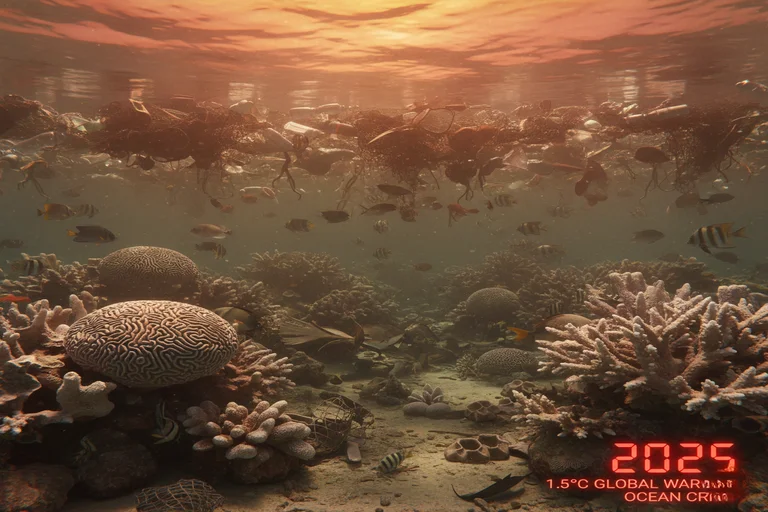
Oceans In Crisis 2025 The Reality Of 1.5°C Global Warming
Our oceans are the lifeblood of planet Earth. They regulate the air we breathe, influence weather patterns, and sustain agriculture worldwide. Yet, as we reach December 2025, the warning signs are undeniable: we are facing an Oceans in Crisis 2025 scenario. Marine ecosystems are destabilizing at a pace that has taken even the most cautious scientists by surprise.
The 1.5°C Threshold: No Longer a Distant Warning
For decades, the 1.5°C warming limit was treated as a safety buffer against climate catastrophe. In 2025, ocean surface temperatures consistently hover at or above this critical mark. This is not just a number—it is the trigger behind cascading effects, from melting polar ice caps to the erratic behavior of currents like the Gulf Stream.
1. Temperature: The Rising Heat of a Global Heat Sink
As Earth warms, the ocean acts as a massive sponge, absorbing over 90% of the excess heat generated by human-induced greenhouse gas emissions. While this has spared us from even more extreme atmospheric warming, the cost to the water has been devastating.
The 2025 Reality:
- Marine heatwaves now last for months instead of days.
- Since the 1950s, heat stored in oceans has increased exponentially.
- In tropical regions, this energy fuels “super-hurricanes” that can intensify from Category 1 to 5 in less than 24 hours.
- 2025 has witnessed record-breaking storm surges in both the Atlantic and Pacific oceans, directly linked to these thermal anomalies.
2. Sea Level Rise: The Encroaching Tide
Scientists now understand global sea level changes more clearly thanks to satellites that continuously monitor ocean levels with far greater precision than traditional tide gauges. Today, in 2025, we rely on advanced, real-time data from NASA’s Sea Level Change Portal to track global sea level trends with high accuracy. These satellites have confirmed that the Oceans in Crisis 2025 situation is accelerating faster than models predicted a decade ago.
Monitoring with 2025 Technology: A Global Perspective
USA (NASA & NOAA): In 2025, NASA and NOAA began using their next-generation satellite altimeters to measure ocean surface heights with millimeter-level precision. NASA is focusing especially on the U.S. Eastern Seaboard and the Gulf Coast, where rising sea levels are posing serious threats to states like Florida and Louisiana.
European Union (ESA): The European Space Agency’s Sentinel-6 Michael Freilich mission is now fully operational in 2025. This satellite updates a global “topographic map” of the oceans every 10 days, covering not just Europe’s coastlines but oceans worldwide. Thanks to this technology, we can now clearly see how melting Arctic ice is altering currents in the North Atlantic.
3. Ocean Acidification: The Silent Chemical Shift
Often described as the “evil twin” of global warming, ocean acidification alters the very chemistry of seawater. When oceans absorb 20–30% of human-produced CO₂, pH levels fall, making marine environments increasingly hostile.
Impact on Marine Life:
The lower pH makes it difficult for “calcifying” organisms—such as oysters, clams, and the foundational coral reefs—to build their skeletons. In 2025, the Global Coral Bleaching Event has reached a tipping point. Scientists report that over 80% of monitored reefs have experienced significant stress this year. If the pH continues to drop, the “calcium carbonate” that forms these structures will literally begin to dissolve, leading to a collapse of the marine food web.
4. Changing Salinity and a Faster Water Cycle
Climate change is rewriting the “salt map” of our oceans. As a global heat sink, the ocean’s rising temperature is accelerating evaporation in some areas while increasing heavy precipitation in others.
The “Salty Get Saltier” Rule:
In 2025, we are witnessing salty regions of the ocean growing even saltier, while fresher areas become increasingly diluted by massive glacial melt. This is not just a chemical issue—it is a circulation crisis. The imbalance is slowing the Atlantic Meridional Overturning Circulation (AMOC), raising the risk of severe climate shifts across Europe and North America by the end of this decade. This disruption of the global water cycle is a key reason we define the current situation as Oceans in Crisis 2025.
5. Deoxygenation and the Spread of Ocean Dead Zones
A topic less discussed but equally dangerous is the loss of oxygen in the ocean. Warmer water holds less oxygen. Furthermore, nutrient runoff from agriculture causes algae blooms that consume all available oxygen as they decay.
In 2025, the number of identified “Dead Zones”—areas where no fish or marine life can survive—has surpassed 500 globally. This is causing a mass migration of fish species toward the poles, disrupting local fishing industries and threatening global food security.
6. The Role of Technology and Human Action in 2025
Despite the alarming data, 2025 has also been a year of technological breakthroughs. From AI-driven ocean cleaning drones to “Blue Carbon” initiatives that use seagrass and mangroves to sequester carbon 40 times faster than tropical forests, there is a path forward.
Experiments like the BIOACID project and new genetic research into “heat-resistant corals” are giving us tools to help marine life adapt. However, these are “band-aids” if we do not address the root cause: carbon emissions.
Read more related articles: https://www.climatechallange.com/how-climate-change-is-creating-dangerous-noise-in-our-seas/
FAQS
Q1: Is it too late to save the oceans in 2025?
Ans.It’s not too late. While some changes are already locked in, drastic reductions in carbon emissions today can prevent a total collapse of marine ecosystems. By acting now, we can help stabilize temperatures by mid-century.
Q2: How does 1.5°C warming affect inland areas?
Ans. Oceans regulate the planet’s weather. When they are in crisis, inland regions experience more extreme droughts, unpredictable rainfall, and higher food prices due to declining fish stocks. Everyone feels the ripple effects.
Q3: What is the biggest hidden threat in Oceans in Crisis 2025?
Ans. The combination of ocean acidification and deoxygenation poses the greatest risk. These changes attack the base of the marine food chain, threatening biodiversity and the stability of ecosystems worldwide.