Rainforest Crisis 2025 Causes, Effects, And Real Solutions
The year 2025 has arrived with a stark realization for the global community: our rainforests are no longer just “threatened”—they are in a state of emergency. Often described as the planet’s lungs, these ancient ecosystems do much more than produce oxygen. They act as the world’s most efficient air conditioning system, a massive carbon storehouse, and a sanctuary for millions of species. However, the Rainforest Crisis 2025 is a global alarm that suggests the pressure on these forests has reached an unprecedented level, forcing us to rethink how we view conservation and climate survival.
What Is a Rainforest?
A rainforest is a dense ecosystem that gets heavy rainfall all year long, often exceeding 2,000 mm annually. These forests are warm, humid, and teeming with life. They are found near the equator, where the combination of sunlight and moisture creates perfect conditions for plant growth.
A rainforest is a thick forest ecosystem that receives high rainfall throughout the year, usually more than 2,000 mm annually. These forests are warm, humid, and incredibly rich in life. Rainforests exist close to the equator, where sunlight and moisture create ideal conditions for plant growth.
Two Primary Types of Rainforest
- Tropical Rainforests: Located near the equator (e.g., the Amazon), these are characterized by high heat and humidity.
- Temperate Rainforests: Found in cooler coastal regions (e.g., the Pacific Northwest of North America).
Why Rainforests Are Critical for Climate Stability
Rainforests play a powerful role in regulating Earth’s climate. They absorb carbon dioxide, release oxygen, and help control global temperature patterns. Trees pull carbon from the atmosphere and store it in their trunks, roots, and surrounding soil.
In 2025, climate scientists are increasingly warning that large-scale rainforest loss could accelerate global warming beyond manageable levels. When forests are cut or burned, stored carbon is released back into the atmosphere, turning rainforests from climate protectors into climate threats.
Rainforests also influence rainfall patterns. Moisture released by trees helps form clouds and rain, not just locally but across continents. Losing these forests disrupts water cycles and increases the risk of droughts and heatwaves.
The Current State of Rainforests in 2025
As we move through 2025, the area of primary tropical rainforests has fallen below the crucial 6.2% mark. Although this might seem like a small drop compared to past decades, the ecological consequences are enormous. We’re losing around 10 to 11 million hectares of forest every year, leading to a devastating loss of biodiversity and climate stability. The Amazon, the Congo Basin, and Southeast Asia’s forests are the key players in maintaining the global climate, but all three are showing signs of severe strain.
The most alarming development this year is the confirmation that parts of the Amazon have officially transitioned from being a carbon “sink” to a carbon “source.” For millions of years, these trees sucked up more CO₂ than they released. Now, due to rising temperatures and fire damage, degraded sections of the forest are actually emitting carbon dioxide back into the atmosphere. This shift represents a major setback in our fight against global warming and highlights the urgency of the current crisis. You can explore detailed country reports and the latest statistics on forest cover via the Global Forest Resources Assessment 2025 by the FAO.
Amazon Rainforest in 2025: A Before and After Reality
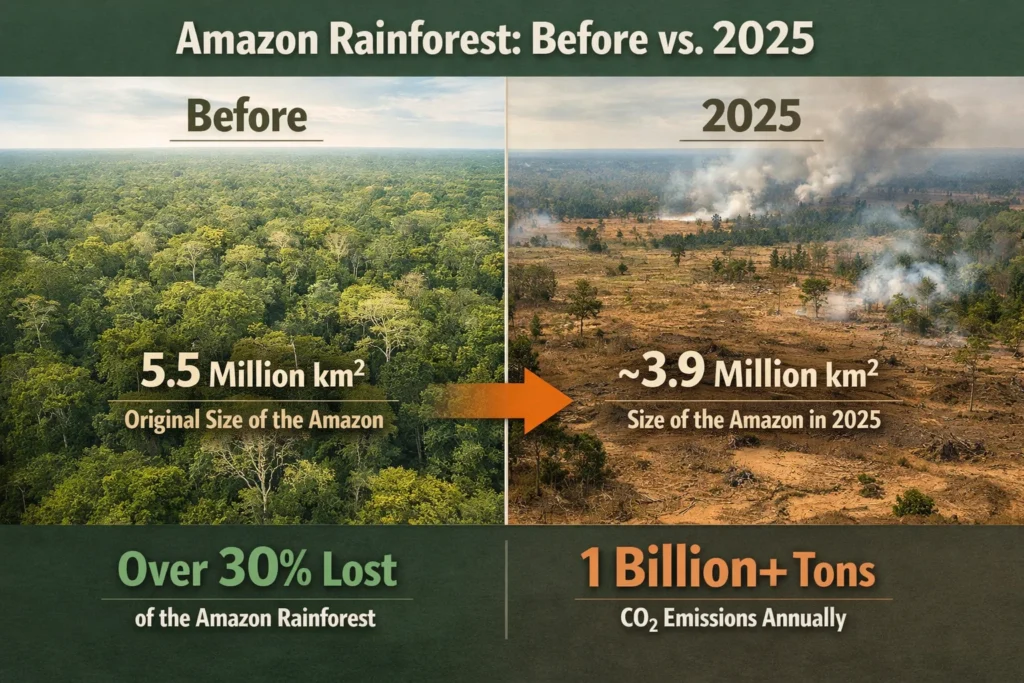
As of December 2025, the data paints a stark picture of the Amazon rainforest crisis. Original size estimates placed the vast jungle at roughly 6.47 million square kilometers. Today, we are grappling with a rapidly changing landscape. The visual difference between a lush, intact canopy and a cleared, burning plain is not just aesthetic; it represents a critical ecological shift.
The 2025 reality involves ongoing significant deforestation driven by agriculture and mining interests. This year saw major fire activity, exacerbated by severe drought conditions linked to climate change. These fires released an estimated 791 million tons of CO₂ into the atmosphere, a staggering amount equivalent to an industrialized nation’s annual emissions. This escalating Rainforest Crisis 2025 is pushing the ecosystem towards an irreversible “tipping point.” Scientists warn that at this point, the jungle could permanently transition into a dry savanna. While targeted enforcement has led to minor localized drops in deforestation rates in some areas, the overarching threat to the Amazon’s survival remains immediate and severe.
Major Causes of Deforestation in 2025
The destruction of rainforests isn’t happening by accident; it is driven by global economic demands that often overlook environmental costs. Industrial-scale agriculture remains the primary culprit. In 2025, the expansion of cattle ranching, soybean production, and palm oil plantations continues to swallow thousands of acres every single day. Even as some countries implement stricter trade laws, the demand for these commodities in emerging markets keeps the pressure high on forest frontiers.
Mining is another significant factor that has intensified recently. As the world pushes for a “green energy transition,” the demand for minerals like copper, nickel, and gold has skyrocketed. Unfortunately, many of these deposits sit directly beneath primary rainforests. Illegal mining operations have expanded deep into protected territories, bringing with them toxic mercury that poisons rivers and displaces indigenous communities. These activities fragment the forest, making it easier for fires to spread and for the ecosystem to collapse.
Infrastructure development also plays a quiet but deadly role. The construction of new highways and dams in South America and Africa often serves as the “opening act” for deforestation. A single road cut through a pristine forest provides easy access for illegal loggers and land speculators. Once the canopy is broken, the interior of the forest dries out, losing the natural humidity that makes a rainforest “rainy.
The Devastating Effects of Forest Loss
The impact of losing these forests is felt far beyond the tropics. One of the most immediate effects is the disruption of the global water cycle. Rainforests function as huge natural water pumps, absorbing moisture from the ground and releasing it into the atmosphere through a process called transpiration. This moisture then travels thousands of miles, eventually falling as rain and supporting agriculture in regions like the United States, China, and Europe. Without these forests, we risk a future filled with unpredictable droughts and widespread food insecurity.
Biodiversity loss is another irreversible consequence. Scientists estimate that we’re losing species at a rate 1,000 times faster than the natural background rate. In 2025, we’re witnessing a “silent extinction” of countless insects, fungi, and small plants that we haven’t even discovered yet. Every time a hectare of forest is cleared, we could be losing the genetic blueprint for a future medicine or a plant that might help us adapt to a changing climate.
Furthermore, the Amazon Tipping Point is no longer a distant theory; it’s becoming a real threat. If the forest degrades by around 20-25%, it will lose its ability to generate its own rain. This would trigger a process called “savannization,” where the once lush jungle transforms into a dry, grassy plain.
How Savannization Impacts the Rainforest Crisis 2025
. Loss of Self-Sustaining Rainfall: The forest will lose its unique biological ability to generate its own rain cycles, leading to permanent local aridity.
. Irreversible Ecosystem Shift: The lush, dense jungle will undergo a permanent transformation into a dry, grassy savanna, destroying the habitat of millions of species.
. Massive Carbon Release: This transition will trigger the release of billions of tons of stored carbon into the atmosphere, significantly accelerating global warming.
. Global Weather Disruption: The collapse will permanently alter weather patterns across the entire Southern Hemisphere, affecting agriculture and water security thousands of miles away.
. Threat to Global Stability: The shift catalyzes the Rainforest Crisis 2025, moving it from a local environmental issue to a direct threat to international economic and social stability.
The Human Element: Indigenous Guardians
We cannot discuss the forest crisis without acknowledging the people who have lived there for thousands of years. Approximately 260 million people, including over 60 million indigenous people, live in or near rainforests. In 2025, it’s clear that lands managed by indigenous communities are some of the best protected on Earth. Where indigenous rights are legally recognized, deforestation rates are up to 50% lower than in other areas.
These communities possess “Traditional Ecological Knowledge” that modern science is only beginning to understand. They know how to manage the forest without destroying it, using it for food, medicine, and shelter in a way that allows the ecosystem to regenerate. Protecting the rainforest in 2025 isn’t just about saving trees—it’s about defending human rights and supporting the people who have proven to be the planet’s most effective guardians.
How We Can Save Our Rainforests Today
Even though the rainforest crisis is serious, 2025 is not just a year of loss—it is also a year of smart action and innovation. One of the most promising responses is the rise of NatureTech. Today, AI-powered satellites and bioacoustic sensors are helping protect forests in real time. These systems can detect the sound of a chainsaw or a heavy truck from miles away and send instant alerts to local authorities. This early-warning technology is changing the fight against illegal logging by stopping damage before it spreads.
Another powerful solution is the push for deforestation-free supply chains. Governments and consumers are no longer willing to accept products that contribute to forest destruction. Goods like coffee, cocoa, and beef are now being tracked from farms to store shelves using digital tools like blockchain. This level of transparency gives consumers real power, allowing their everyday purchasing decisions to directly support rainforest protection.
At the same time, large-scale reforestation efforts are gaining momentum—but with a smarter approach. Experience has shown that planting trees alone is not enough. The focus has now moved toward forest landscape restoration, which prioritizes native species, healthy ecosystems, and long-term benefits for wildlife and local communities. In 2025, success is measured not by how many trees are planted, but by how well restored forests can truly thrive.
The Future of Rainforests: A Choice We Must Make
The Rainforest Crisis 2025 reflects the choices we are making as a global society right now. We stand at a turning point. Continued neglect will push the planet toward a hotter, drier, and less diverse future. But another path is still open. By standing with Indigenous communities, using new technology wisely, and holding corporations accountable, we can protect these vital ecosystems and begin to reverse the damage driving the Rainforest Crisis 2025.
Saving rainforests isn’t just an act of kindness toward nature—it’s a matter of survival for humanity. As this decade unfolds, the choices we make will determine whether the “lungs of the Earth” can recover their strength or continue to fade. The science is clear, the solutions are within our reach, and the time to act is now. Protecting rainforests could become the most powerful legacy we leave for future generations stepping into the late 21st century.
Read more related articles: https://www.climatechallange.com/endangered-amazon-trees-why-protected-areas-arent-enough/
FAQS
Q1. Why are rainforests called the lungs of the Earth?
Ans. Rainforests absorb vast amounts of carbon dioxide and release oxygen through photosynthesis. While oceans produce more oxygen overall, rainforests play a vital role in stabilizing the climate and air quality.
Q2. How do rainforests affect weather patterns?
Ans. Rainforests release moisture into the atmosphere, helping create rainfall locally and across distant regions. Their loss disrupts global weather systems and increases extreme events.
Q3. Can rainforests recover after deforestation?
Ans. Rainforests can regenerate if given time and protection, but old-growth forests take centuries to fully recover. Preventing destruction is far more effective than restoring damaged land.